Movie Report: Netflix’s The Dragon Prince

Genre: Children’s fantasy animation
Released September 2018 – current (the fourth season is expected to be released later this year or early in 2022)
Rated PG

Brief Summary
The world of Xadia is divided between the humans, who practice dark magic, and the elves, who use primal magic. The border between them is protected by the King of Dragons, whose only egg was destroyed years ago by the humans.
Callum and Prince Ezran find the last dragon egg and set out on a journey with elf Rayla, to return the egg to the Dragon King and restore peace to Xadia. But there are many who do not want them to succeed and do everything they can to stop them.

Credit: Netflix

When I was about ten years old, I set out on a quest to find a book with a leading deaf character. I didn’t want just any random book. I specifically wanted a medieval fantasy story, with a female, deaf knight, and involved dragons. I was so determined to find this story that I got up the courage to ask the school librarian for help. We didn’t find anything available in the library, so I looked on the internet, which also had nothing. I came to realize that if I wanted to read a story about a deaf knight and dragons, I would have to write it.

Well, that all changed when I got to watch Netflix’s original series The Dragon Prince, which has General Amaya, one of the highest-ranking military official in Katolis, entrusted with guarding the human side of the Border, sister of the late Queen Sarai, Aunt to two of the show’s main protagonists Callum and Ezran, and who happens to be deaf and uses American Sign Language (ASL) to communicate.

General Amaya, front and center, with her trusted advisor Commander Gren (left) and her nephew Callum (right). Credit: Netflix

Getting my childhood dream at the age of twenty-two, you bet I cried. While it wasn’t the first deaf character I have come across, General Amaya was the first portrayal of a deaf person in a position of power and who plays a big role across the story that I have experienced. In general, the whole show is amazing on so many levels. It was literally designed to push for diversity and representation. For that reason alone, it comes across as special and meaningful because so many minorities are being represented at once—and in positions of power! You have LGBTQ+ queens and assassins, so many powerful female leaders, and people of color by the dozen (among both elves and humans).

Not only is General Amaya deaf, but she uses real sign language—like proper grammar and everything. It’s not just a few token signs to help sell the part. And—something else that is noticeable—when she speaks, there are no subtitles to translate what she is saying. You have to know sign language to understand. I think this choice has a powerful impact because it allows the audience to see her differently. Plus there are some hilarious jokes you’ll only catch if you know sign language.
I did some more research into this. The ASL was so good, I wanted to know if there was a deaf person involved in the creation of this character. It turns out that one of the show’s co-creators, Aaron Ehasz, asked the question “What if [General Amaya] is deaf?” Ehasz also worked on another famous show Avatar: The Last Airbender, and is responsible for the tough-loving, sassy Toph, a blind earthbender. In creating General Amaya, Ehasz and the other producers reached out to several Deaf and Hard-Of-Hearing organizations, met with several deaf people, and worked with several ASL interpreters to make sure Amaya’s signing was authentic.

General Amaya is also in a position of power—one of the King’s most trusted advisors and one of the highest-ranking Generals in the Katolis Army. Serving in the military alone is something extremely meaningful and powerful for the Deaf and Hard-Of-Hearing community. In America, disabled citizens are not allowed to join the army or serve in any related military role. Now, that might come off as strange to you and maybe you can think of a few examples of disabled veterans who are actively working in the military. That’s because the US military has a loophole. If a soldier in the military acquires a disability during active service, the military will make all accommodations necessary for them to continue doing their job. So there are people with disabilities serving, but only able-bodied people are allowed to join.

“If the US military can retain their disabled soldiers, why can’t they accept disabled citizens?”

Keith Nolan

This becomes even more questionable when looked at from a global standpoint. America is one of a small handful of countries that do not allow people with disabilities to serve, in contrast to the rest of the world where they are allowed and even encouraged to serve. Or, if you look at this issue from a historical standpoint, there have been deaf soldiers serving in every single war in US history up thru WWII.

Credit: Keith Nolan

Keith Nolan, a deaf man and a teacher at the Maryland School for the Deaf, has been fighting for years to get the military to open for the Deaf and Hard-Of-Hearing. He participated in an ROTC program for two years and was able to earn the rank of a cadet private before he was barred from advancing any further simply because he was deaf. Nolan also traveled to several other countries to interview deaf soldiers actively serving in military roles and wrote a 98-page paper on why the Deaf should be allowed to serve.

“If you remember back in US history, African-Americans were told they couldn’t join the military, and now they serve. Women as well were banned, but now they’ve been allowed. The military has and is changing. Today is our time. Now it’s our turn. Hoorah!”

Keith Nolan

Nolan’s activism was successful up to the point that a bill, named after him, was drafted and sent to congress. The bill would open up a test program for the Deaf in the Air Force. If it went well, it would open the doors to regular service and test programs in other branches of the military. Unfortunately, the bill suffered from bad timing. Obama was a big supporter of Nolan, but the bill didn’t reach congress until Trump was in office. Trump has never been supportive of disability civil rights. Thus the bill ended up getting swept under the rug.

The topic of deaf in the military hits home for me. I remember the first time I was ever asked the question “What do you want to be when you grow up?” I was in kindergarten and still learning how to write. All the other kids were writing down that they wanted to be doctors, lawyers, firefighters, veterinarians, but I decided I wanted to be a soldier. I still have that assignment tucked away in one of my memory boxes.

It’s not something I talk about a lot. I used to tell people that I wanted to be a soldier, but apparently, I have such a reputation for being kind, that my friends and family laughed at the idea of me being a soldier. Growing up, it never crossed my mind that I wouldn’t be allowed because I was deaf. When I was seventeen years old, I started doing more research as I knew there were early military programs for high school students. That’s when I found out that I would never even been given a chance. That put me in a dark place for a long while. But I still hold out hope that things will change and maybe I’ll still have the chance.
To learn more about Keith Nolan’s story, you can listen to his TEDtalk, check out his website, or read more about the Keith Nolan Air Force Deaf Demonstration Act of 2018.

Coming back to The Dragon Prince, that’s one of the reasons that General Amaya is such a powerful representation. She is an example of something the Deaf community is actively fighting for. She represents hopes and dreams and inclusion and recognition.

Now, I wish I could leave this blog post at that, but if you recall my last blog post, I introduced my own literary theory about the nullification of disabilities. As much as I hate to throw General Amaya under the bus, she does fall prey to this.

General Amaya is introduced to viewers as a nonverbal character, meaning she relies on sign language for communication. So either people know sign language to communicate with her, like her nephews Callum and Ezran, or as it turns out, she has an interpreter, Commander Gren, to communicate with those who don’t know sign language. Everything is great.

That is until General Amaya assigns Gren to stay at the castle and keep an eye on Viren, while she goes on to check the border. Now, of course, deaf people do not require an interpreter at all times. There are plenty of other ways to communicate. The issue with this is that the writers didn’t show how Amaya communicated without an interpreter. Do her soldiers all know some sign language and that’s how they communicate? Is there another interpreter? General Amaya is in a powerful position where she is communicating with others all the time. By removing Gren and not showing how she communicates otherwise, it ends up nullifying her disability by refusing to acknowledge and respect the limitations of her disability.

Commander Gren signing with General Amaya, Credit: Netflix

Unfortunately, it gets worst. After she leaves Gren, she seems to gain the ability to lipread everything. There are scenes where Amaya is in a room full of people speaking verbally and she follows the conversation without any questions.

I have said it before and I’ll say it again, lipreading is extremely inaccurate! Lipreading at best—at best—can give you 30% of what someone says, depending on the language. If it is a tonal language (meaning words change based on the tone of voice, such as with Mandarin), you’ll get even less. In addition, lipreading has so many factors—how expressive someone’s face and body is, how fast they talk, if they mumble their words, and we haven’t even gotten to accents yet or being in the right mindset to lipread. Lipreading is exhausting work. I’ve had times where I am so tired at the end of the day, trying to lipread is like trying to understand a foreign language. When I reach this point, I say “I can’t understand English right now.” People laugh at that because they think I’m being funny, but really, I’m being serious. Basically what I’m saying is relying on lipreading alone is the crappiest form of communication on the face of the planet. It only works when it is put together with other things—like knowing the context of the conversation.

Yet, General Amaya doesn’t seem to have any of these issues. But wait—it gets worst (again). In Season 3, General Amaya is taken captive by Sunfire Elves. Now, the elves have a completely different set of cultures and languages than humans do. Yet, despite having no experience with elvish dialects and accents, General Amaya seems able to lipread most of what they say. Not all of it though, as they do bring in a non-native sign language interpreter into the story when they are interrogating General Amaya in a ring of fire.

To draw from my own experiences, I have a lot of opportunities to work with people who speak Spanish as a first language. In some cases, I have worked with the same people for years and let me tell you, even though I’m familiar with the Mexican accent, I struggle to lipread it. It’s like trying to lipread a foreign language. That’s why I’m saying General Amaya being able to lipread the Sunfire elves doesn’t make sense. These elves have a completely foreign accent and English is not their first language, so it doesn’t make sense that she can lipread what they are saying. In addition, she is not always at her best. In the ring of fire scene I mentioned above, she’s weak and beaten down, which would affect her ability to lipread in the first place because it takes so much mental effort to try to piece together what someone is saying even under fair conditions.

So in short, General Amaya, as awesome as she is, is a good example of nullification by refusing to acknowledge and respect the limitations of a disability. When the limits of a disability are not respected, it ends up reinforcing stereotypes. In this case, it encourages the myths that lipreading is 100% accurate and that all deaf people have an innate ability to lipread. These myths, which are already common beliefs among able-bodied people, then affect the lives of deaf people. I hate it when people just expect me to lipread what they say and refuse to listen to the accommodations that I actually need to communicate. Like when I ask for something to be written down, they refuse and point at their mouth and keep repeating what they say. In other cases, I’ve had people grab me, pull me into their face so that they speak directly into my hearing aid as if that’s going to make things clearer. It’s frustrating and uncomfortable. But it’s also frustrating because I can’t fault others for doing this as they have never been taught otherwise.

With all that said, I still love General Amaya. She is my favorite character in the series and it is so cool to see how much she is involved in the story! She’s not some token side character. She’s almost a main character at this point. I will never forget the moment that I first saw her appear on screen, the way I did a double-take when she started signing, the way the realization hit me, and the tears started flowing—this is the story I’ve been waiting for my whole life to hear, the story I’ve been looking for since I was ten. She is such an amazing character, representative of so much more than just being deaf, and her signing is authentic ASL. Her portrayal is not perfect, as I pointed out the issues with her lipreading, which leads to the nullification of the disabled experience and which directly impacts people’s perceptions and understanding of disabilities. Because like it or not, most people are introduced to disabilities through a screen, that’s why increasing accurate representation and visibility is so important to the disabled community.

The Dragon Prince is an amazing story to watch and it has so many unique elements in it. It is one that I highly recommend. And it is family-friendly too. I am excited to see the next season, which is expected to be released sometime this year or early in 2022.

What’s on your “to be watched” list? Got any recommendations for me? Comment below and let me know!
Writing Disabilities, Part 2: The Nullification of Disabilities

I was first introduced to disability studies through a critical literary studies class, a basic requirement for English majors where students learn different theories or “lenses” for analyzing literature. This includes theories such as deconstructionism, Marxism, Colonial and Racial studies, among several others. But I noticed that we weren’t assigned to read the last chapter of our textbook, which was about contemporary fields of study and included a small section on disability studies. Naturally, I was curious and read it. While the scant twelve pages had a lot of interesting points to ponder, I found it disappointing. The reason I was disappointed was that it failed to explain trends I have observed over the course of my life about characters with disabilities. I ended up creating my own theory to explain these trends and presented it as part of my final presentation for the class. Since then, I have been revised it countless times. Today, I’m proud to finally share it with you!

This theory is called the nullification of the disabled experience or the nullification of disabilities for short. The gist of it is to examine the relationships between power and disabilities. Because disabilities are associated with many harmful stigmas and with the lower class, disabilities and power are not presented together. Take for example the 32nd president of the United States, Franklin D. Roosevelt, whom I mentioned in a previous blog post. Roosevelt had polio and was paralyzed from the waist down, thus used a wheelchair and other mobility devices. However, he refused to be photographed with his wheelchair because of the stigmas associated with being disabled. He wanted to appear as normal as possible so people would take him seriously and not assume he was weak and feeble. He would use braces under his pants and walk with the aid of a family member to help hide his disability from the public, even though his disability was common knowledge. Roosevelt was essentially trying to “nullify” his disability in the eyes of the public to maintain power, trust, and status.

Roosevelt serves as a good example of how disabilities and power have conflict. Anyone can tell you that the appearance of power is important. The way disabilities are present in stories is equally important. Because of the conflicts between disability and power, they are often not presented as coexisting. When one appears, it often nullifies the other. This can happen in several ways. For example, if a character has a disability, then gains power—the disability becomes ignored or washed away. On the flip side of the coin, a character can be in a position of power, from which they are removed when they acquire a disability. Or another common narrative, a character seeks a cure or must otherwise overcome a disability in order to be powerful enough to defeat the big bad evil force of the story. But the simplest way a disability becomes nullified is when the limitations of a disability are ignored.

The last one is probably confusing to you. After all, isn’t part of the reason I run this blog is to help people see past the limitations of disabilities? This is true; I run this blog is to fight against the stigmas and stereotypes surrounding disabilities. But fighting against stigmas is a little different than acknowledging limitations. (Granted there is an overlap). The point here is that acknowledging and remember the limitations of a disability is a sign of respect. Ignoring limitations silences our struggles and denies that discrimination exists. But going too far to the other side by letting our limitations take center stage, will also encourage stereotypes and stigmas, which further results in overshadowing the capabilities and contributions of those with disabilities.

Think of it this way. I am a deaf person. My coworkers acknowledge the limitations of my disability by making sure they get my attention before speaking to me. They make sure to pull their face masks down so I can lipread. When I worked in a factory, my coworkers would stop machines to eliminate background noise before communicating with me. By taking these steps and accommodating my needs, they are being very respectful. It is an act of empowerment to acknowledge, accept, and respect my limits. Whereas if they don’t pull down their face masks or take steps to communicate better with me (ignoring my limitations) comes off as disrespectful.

Interestingly enough, this is the critic’s argument against the social model of disabilities. The medical model focuses only on limitations through the person’s body whereas the social model only looks at society and cultural factors. The social model doesn’t acknowledge the limitations of individuals’ bodies.

Bringing the idea of acknowledging limitations into the field of literature, I cannot tell you how many times I have seen disabled characters in TV shows or movies portrayed so accurately and amazing in the beginning, but as time goes on their limitations are ignored more and more. Which ends up nullifying the disability because the character is doing things that they shouldn’t be able to do. For example, lipreading. Lipreading is extremely inaccurate and yet, most Deaf characters I have seen on the screen can lipread every single word flawlessly. It drives me crazy! Lipreading is so much more complicated than it is presented on screen and it encourages stigma. (Check out this four-minute video that explains the complexities and issues with lipreading so much better than I ever could).

Representation like this is a slap to the face for the disabled community. Disabled individuals do not have the luxury of choosing when our limitations apply and when they don’t. By ignoring limitations when they become inconvenient, writers and directors end up nullifying the disability. It’s like saying, “We are representing a minority community—but they’re only sometimes disabled because being able-bodied is much more convenient and powerful for the story.”

I recognize this may not be the intention of the writers and directors, but it happens regardless. This is why—to be inclusive—there needs to be more people with disabilities involved in the workforce and especially in the creation of characters with disabilities. They are the ones who are going to spot inconsistencies and inaccessibilities that nullify what it is like and what it means to have a disability.

Maysoon Zayid, an actor, writer ,tap dancer, disability advocate, and comedian

As I was writing this post, I recalled a hilarious TEDtalk given by Maysoon Zayid who has cerebral palsy: “I got 99 problems . . . palsy is just one.” In college, she participated in the theater program. When the theater announced they were going to put on a play where the leading role was a character with cerebral palsy, Zayid thought she had been born to play it. She went through the whole audition process and didn’t get the part. Instead, it went to an able-bodied peer.

Understandably upset, she met with the director to ask why. He gently explained the reason she didn’t get the part was because she couldn’t do the stunts.

“Excuse me!” she said. “If I can’t do the stunts, then neither can the character!”

This illustrates an important point in the representation of disabilities. I briefly mentioned this in a previous blog post about the representation of disabilities in Hollywood. 5% of all roles in Hollywood are for disabled characters. Of that 5%, only 2% of those roles go to disabled actors. The other 98% are played by able-bodied actors. This means that the disabled community (which comprises about 30% of the US population and well over a billion people worldwide) is being represented by .001%.

Because disabilities are often invisible and because anyone can acquire a disability at any given time, Hollywood gets away with able-bodied actors in disabled roles. Whereas other minorities—people of color, women, and those with alternative sexual orientation or gender identities—usually have visible characteristics, so Hollywood can’t get away with it as easily. Respecting, remembering, and acknowledging the limitations and the capabilities of those with disabilities is an act of empowerment. And the best way to learn about those limitations and capabilities is to learn directly from us.

So that is how disabilities can be nullified by ignoring limitations. Another way nullification happens is when a disabled person gains power, their disability will disappear—or vice versa, when a person in power gains a disability, their power disappears. Naturally, this sends several problematic messages about disabilities. A great example of this comes from the Marvel Cinematic Universe, Dr. Steven Strange.* Strange starts off being in a position of power as a genius (albeit arrogant) surgeon. Later, he gets in a car crash which destroys his hands and ends his career. Strange’s life is presented as hopeless, dark, and dreary. Thus, when he became disabled he lost his power and his status—nullification of power by acquiring a disability. In pursuit of a miracle cure, Strange ends up in Nepal training in the mythic arts where he struggles a lot and blames his inability on his hands. When he does finally get the hang of magic with the use of a sling ring, from that point onward, we never see him struggling with his disability again. He appears able-bodied. So when Strange regained power, his disability seemingly disappears. That’s the nullification of disability by power gain, which results in ignoring the limits of his disability. The next time (and I believe the only time) his hands noticeably shake following his gain in power isn’t until several movies later in Avengers Endgame when Strange hands over the timestone to Thanos.

I have so much more to talk about with Dr. Strange, so look out for a blog post in the near future where I will dive deeper into everything I said above and more!

*September 2021; Writing on this character has been my most difficult blog post yet. Originally, I was planning to use this film as an example of my nullification of disability theory. In preparation, I rewatched the film and realized while this film does have moments of arguable nullification, as a whole, the film does an amazing job at acknowledging Dr. Strange’s disability. Check out my revised take on Dr. Strange here!

Image: Marvel Studios

The message that this sends is that a person with a disability cannot hold power or be in a position of power. Furthermore, it reflects an expectation that a disabled hero cannot accomplish the same thing as an able-bodied hero.

To go further, the nullification of disability by gaining power is also common with temporary disabilities. Even an injured character—an example of a temporary disability—is often quickly healed or cured of anything that could make them less powerful or seemingly incapable of achieving their goal. For example, most science fiction and fantasy tend to have technology or magic with the ability to instantly or almost instantly heal injuries.

I think a big reason behind this is that when a writer has a character with a disability because they haven’t been taught very much about disabilities or have lacked access to the subject, they think of the disabled character as “useless.” Thus, finding a way to restore that “usefulness” quickly and reliably takes precedence.

I will admit this is something that I struggle with as a fantasy writer. Injuring characters is a great way to ramp up the stakes and build tension in a scene. For example, in one of my works I have a high-stakes chase scene with a character who ends up taking an arrow to the shoulder. Originally, I had planned for the healer on the team to instantly restore him to an able-bodied state because he has to fight in another big battle shortly after the chase. Without that instant heal option, I have to think about my story differently. How long a wound like that would take to heal naturally? I could give him a minor flesh wound (so he has time to heal naturally) or he could be fighting with his injury—which might not be such a bad idea because I can see it adding tension if done right, especially if he ends up having to sneak around the King’s patrols.

Now, I am not saying that no one should write stories with an “instant heal” or “restoration of able-bodiedness” option. If that is where your imagination takes you, I encourage you to follow it. For me, it has become a personal choice not to have instant heal as an option because I am so interested in exploring the disabled experience on the page. My intention in sharing this side of the coin is to show that there are other options. Instant heals, I feel, are something that has been done over and over. It has become something of an expectation. It’s been ingrained in stories since writing was invented and was probably around for thousands of years before that through oral storytelling. (Fun fact: the Bible is based on stories originally written in cuneiform, the oldest discovered writing system in the world which was first used around 3400 BC).

I, for one, refuse to believe that disabled characters cannot be in positions of power, nor that they cannot participate and play valuable roles in high stake plots. Writers haven’t been taught to explore the perceptions of power in regards to disabilities. Since literature embodies, reflects, and critiques culture, based on what I have seen, there seems to be a deep fear within our culture about disabilities. It is time to start exploring that fear, to question it, and to make apparent what we are really afraid of. What will happen when disabilities are allowed to linger on the page and be seen? What happens when disabled heroes are allowed to save the day?

At this point, hopefully, you are starting to see possible applications of the nullification of disability theory. If you feel that you are struggling with the concept, that’s okay. Critical literary theory usually makes more sense in application than in explanation. This post is meant to serve as an introduction. Over the coming weeks, I will be applying the nullification of disabilities theory to several different works of literature.

Don’t forget to like this post and/or leave a comment below!

FOR FURTHER READING

Goddess in the Machine – discusses a disabled character who is in a position of power and how the limitations are acknowledged

Netflix’s The Dragon Prince – nullification by ignoring limitations

The Inheritance Cycle by Christopher Paolini – nullification by overcoming a disability and power gain

James Cameron’s Avatar – is it nullification?

Book Report: The Wonky Donkey by Craig Smith and illustrated by Katz Cowley

Genre: Children’s Fiction
Published May 1, 2010

Summary
Enjoy tongue-twisting fun as readers get to know more and more about the life and personality of the Wonky Donkey with each turn of the page.

Good morning Listen Up readers! Today I am talking about one of the most popular children’s books on the market. In fact, The Wonky Donkey (TWD) has been a best seller for several years. As of writing this, it is listed as Amazon’s #1 Best Seller in Children’s Farm Animal Books and maintains a 5-star rating out of nearly 60,000 reviews. This is impressive considering how competitive the children’s book market is.

For those who are not familiar with the book, it follows a Donkey who uses a prosthetic leg (hence, how he got the name “wonky)” as he goes about his life. But the words used to describe the Donkey and his characteristics are subtly controversial. Nearly the entire first page of reviews on Amazon are 1-star ratings because of the word choice. The majority of other reviewers left 5-star ratings, often saying they were disappointed in the 1-star ratings and told others to “lighten up” about the word choice. I have included a few screenshots of these reviews. The following were retrieved on May 17, 2021, and were found on Amazon’s first page of reviews.

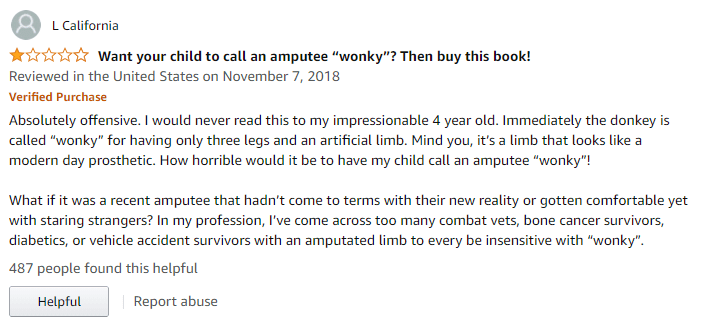
Review by L California, titled “Want your child to call an amputee ‘wonky’? Then buy this book!” 1 star rating

“Absolutely offensive. I would never read this to my impressionable 4 year old. Immediately the donkey is called ‘wonky’ for having only three legs and an artificial limb. Mind you, it’s a limb that looks like a modern day prosthetic. How horrible would it be to have my child call an amputee ‘wonky’!

“What if it was a recent amputee that hadn’t come to terms with their new reality or gotten comfortable yet with staring strangers? In my profession, I’ve come across too many combat vets, bone cancer survivors, diabetics, or vehicle accident survivors with an amputated limb to every be insensitive with ‘wonky’.”
Review by Tidbit, titled “What’s not to love?” 5 star rating

“I have to be honest, I bought this book for myself. I’m a 62 year old grandmother whose grandmother whose grandchildren are all grown up, or enough that they don’t sit on my lap anymore. I loved this book. I’m disappointed that the very first review was 1 star because the write didn’t approve of the word “wonky” get over it. There are a lot of words that may not be proper, but this one hits the nail on the head. Thank you for my smile every time I read the book.
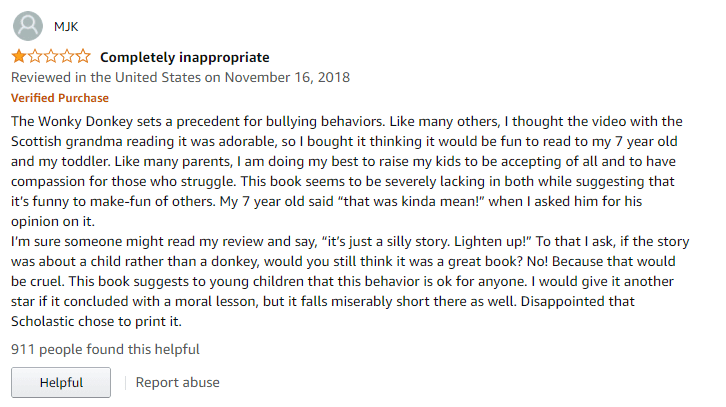
Review by MJK, titled “Completely inappropriate,” 1 star rating

“The Wonky Donkey sets a precedent for bullying behaviors. Like many others, I thought the video with the Scottish grandma reading it was adorable, so I bought it thinking it would be fun to read to my 7 year old and my toddler. Like many parents, I am doing my best to raise my kids to be accepting of all and to have compassion for those who struggle. This book seems to be severely lacking in both while suggesting that it’s funny to make-fun of others. My 7 year old said ‘that was kinda mean!’ when I asked him for his opinion on it.

“I’m sure someone might read my review and say, ‘it’s just a silly story. Lighten up!’ To that I ask, if the story was about a child rather than a donkey, would you still think it was a great book? No! Because that would be cruel. This book suggests to young children that this behavior is ok for anyone. I would give it another star if it concluded with a moral lesson, but it falls miserably short there as well. Disappointed that Scholastic chose to print it.”

When I first read this book, I wasn’t sure what to think. I didn’t feel the author intended to make fun of the Donkey’s disabilities and it didn’t seem that offensive to me. But then I do not use a prosthetic or an eye patch. To help myself understand this issue better, I decided to ask myself how I would feel if the Donkey used hearing aids and was called something like “The Echoing Donkey.” This would be extremely insulting to me as a Deaf person. I regularly have to ask people to repeat things they say, then I repeat it back to them to make sure I understood what they said. It is a vital strategy for me to communicate and it isn’t easy. To have someone make a joke of that makes me angry. In this sense, words like “wonky” or “winky” are not mindful terms for someone who uses a prosthetic or an eye patch.

Can you imagine someone referring to Nick Fury as “winky?”

As I said, I don’t think the author intended to make fun of disabilities. I think he was focused on making a funny book and was largely successful. But the book does end up playing on ableist ideals which serves as an unconscious reflection of our culture’s perspective toward disabilities. What I mean by this people are opinionated when it comes to disabilities. My last series of blog posts covered the history of disabilities and the history of the disabled civil rights movement. One of the most challenging things that disabled civil rights activists faced was getting people to acknowledge that discrimination against disabilities did exist. I think that comes into play with TWD and why some people are fine with it and others are against it.

Because this seemed to be a controversial book, I wanted to have a second opinion on it. So, I decided to ask some of my friends who happen to be teachers, what they thought about the book and if they would include it in the classroom. Out of respect for their privacy, I will refer to them as Teachers A, B, C, and D.

Teacher A teaches kindergarten. When I pulled out my copy of TWD, she was excited as it was a book she had been considering for use, but initially decided against it because it mentioned coffee. (Coffee is a controversial subject in the state of Utah). She talked about the importance of kids learning to rhyme and the way it was used in TWD would help kids learn to build self-awareness. She saw the book in a very positive light as getting to know the Donkey beyond his disabilities.

Teacher B is a special education teacher. He didn’t like the book as he felt it was assigning labels. He also said that he wouldn’t use this book in the classroom from a practical standpoint, as rhymes are difficult for some of his kids. Which is a point I had not considered. It brings up a whole different perspective on the subject of writing inclusively when talking about writing for an audience with disabilities, but that is also an entirely different subject which I won’t be able to get into it today.

Teacher C, who is working toward her degree in education, had strong opinions on TWD. She pointed out the words used to describe the Donkey all had negative connotations and felt that the book in general was reinforcing stereotypes. “If it is not going to educate or show the beauty of disabilities, then it is ableist,” she said.

Teacher D is also working toward a degree in education and is a mother. Like Teacher A, she recognized that learning rhymes and self-awareness is important for kids. It is a fun book to read for both children and adults. But like Teacher C, she noticed the word choices all had negative connotations. “Disability isn’t really being represented here,” she said, “because it is an animal. It is using the missing leg and missing eye as something to laugh at.” She ended by saying that she would not use it in a classroom or read it to her kids.

Post-discussion, all the teachers said they would not use TWD in the classroom. This includes Teacher A, who had a positive perspective of the book at the beginning, but by the end of hearing what others noticed and thought about the book, said that she wouldn’t use it even if it didn’t mention coffee. She pointed out that there were plenty of other books available that teach kids rhymes and self-awareness which are more inclusive.

TWD has two sequels, The Dinky Donkey and The Grinny Granny Donkey, which are about the Donkey’s daughter and mother. The word choice in these books is similar to that of TWD, meaning that many of the words used to describe the characteristics of the main character have negative connotations, though the characters themselves don’t have disabilities. Which sparked a new train of thought in my brain.

Donkeys, because they are associated with labor and lower class standing, are not thought of as being majestic creatures. Donkeys are generally expect to be dirty, smelly, stubborn, stupid, and grumpy. In that sense, the negative word association fits within that context. If TWD was a story about a donkey without disabilities it would probably be socially acceptable. Maybe the Donkey is having a bad day and stubs his toe and walks a little wonky from that. Then he gets something in his eye and becomes winky trying to get it out. The words haven’t changed, but the story isn’t as controversial anymore. Yes, readers are still laughing at a donkey, but in our society, it seems to be more socially acceptable to laugh at a dirty, stinky donkey than a dirty, stinky, disabled donkey.

All in all, The Wonky Donkey is a short book that sparks a lot of thought on the subject of stereotypes, word choices, and cultural perspectives. It also highlights a lack of awareness and education among writers and publishers on issues surrounding writing disabilities. On a personal note, my biggest issue with TWD is that this it is a children’s book. Books such as this start teaching ableist ideals to young children, thus encouraging another generation to continue believing the stigmas surrounding disabilities and the illogical exclusion of disabilities from society and stories. These issues are subtle in TWD, but important issues nonetheless.

What is your opinion on The Wonky Donkey? Comment below and let me know!
In my previous post, I mentioned that I might be switching to posting every other week rather than weekly. I have decided to proceed with that. This will allow me to have a better work-life balance, enable me to work on other writing projects while continuing to write quality blog posts for you. Thank you for your understanding and continued support!

Writing Disabilities, Part 1

Three Ethical Questions on Writing Inclusively

If you’ve been hanging around for a while, then you know I started this blog because there are not many disabled characters or disabled voices on the literary market. I have been planning this writing series since the day I started thinking about creating a blog. If you haven’t already, check out the “Disability History” series as it provides a strong base for understanding disabilities as built by cultural means, which lends itself to world-building and designing characters with disabilities.

First, a little side note about this blog: I will not be posting next week as I have switched to working full-time recently and have since been struggling to keep a work-life balance. Since May is Mental Health Awareness month, I have decided to take a short break because I have been feeling some burnout from my new schedule. I am considering switching to writing posts every other week instead of every week, so I’ll keep you guys in the loop about what I decide to do. And don’t forget to check your mental health too. It’s okay to not be okay. What is important is to take care of yourself and reach out. No one should have to fight alone.

From the moment I learned to read, I always had my nose in a book. Every recess, I would take two steps out the door, sit on the steps, and read while all the other kids ran around playing. When I was ten, I started writing my first novel, which was terrible, but my teacher kept encouraging me and so I never stopped writing. Now I am a graduate of Weber State University with a Bachelor’s degree in Creative Writing. Throughout my life, I have been unconsciously educated and observing trends regarding disabilities in stories.

While I did not have the knowledge or words to explain the things I was seeing until I got to college, I was recognizing the absence of disabled characters by the time I was eight or nine years old. When I took a nonfiction writing class, I struggled to write about myself. I had no idea how to put my disability on the page because I had never been exposed to work by other disabled authors. In trying to find tips to help me, I found nothing. Instead, I went through a long process to develop my methods and ideas for writing disabilities. It has been a life-long undertaking and I’m still learning. I am proud to share my experiences with you and to give valuable writing advice for anyone who wants to know how to write characters with disabilities better.

My philosophy is to encourage all writers, regardless of whether they are disabled, nondisabled, had a disability in the past, are not disabled but have a family member who is, or identifies anywhere in between. It is not my intention to tell writers how to write or what to write. Rather, the goal is to equip writers with tools, perspectives, ideas, and a deeper understanding of what it means to be disabled to apply to their writing.

So, why is there such a gap of disabled characters and authors with disabilities in the literary world? There are several reasons for this. Disabled people have been oppressed for centuries, which means that they are often an afterthought and more commonly, people believe they aren’t worth telling stories about. Over the last few decades, these ideas have been increasingly challenged as the disabled community has received civil rights and is no longer being segregated from society. Though, there is still a long way to go. For example, book publishers tend not to publish works by disabled authors or works with leading disabled characters because publishers assume the disability narrative is not relatable (meaning it will not sell well). Progress has been made in this area and a few publishers are actively seeking out work by disabled writers, but the gap remains.

Another longstanding issue facing disabled authors is, depending on their disability, their manuscripts may have more errors than a nondisabled author. They may not be able to sit at a computer and type or edit. A simple answer to this would be to hire someone to edit or type as needed, but such help is hard to find and frequently expensive. This causes a conflict as publishers expect highly polished work and may not be willing to put in the extra work to be inclusive.

That is a brief introduction to why there aren’t more disabled voices on the literary market. These are barriers that are actively being challenged, especially with the increasing popularity of self-publishing. I believe that we will see an increasing number of disabled writers and characters with disabilities as time goes on.

With that being said, there are ethical questions that are important to discuss when it comes to portraying characters with disabilities. Here are three big questions to help you think about issues in writing characters with disabilities.

1) Referring to characters with disabilities

It is often surprising to nondisabled people that what they think is an appropriate term to refer to someone, turns out to be offensive. For example, deaf and hard of hearing people prefer to be called “deaf” or “hard of hearing” over “hearing impaired.” This is because being called “impaired” has a negative connotation and suggests that the person is broken. Therefore, it is offensive. But the word Deaf represents identity and culture, which is why you’ll see it capitalized in some contexts. This idea is confusing to nondisabled people because “hearing impaired” sounds more polite to them.

This concept also applies to DeafBlind people and Autistic people. In other cases, such as with mobility devices, a different approach is used. A person in a wheelchair is called “a wheelchair user,” but I’ve seen several works that say it like “a person confined to a wheelchair.” This suggests that wheelchairs are like prisons instead of being a form of assistive technology that enables them to participate more fully in society. It also suggests that being in a wheelchair is a terrible, undesirable thing, but it isn’t. There is no reason why a wheelchair user cannot live a life as full and adventurous as someone who doesn’t use a wheelchair.

If you are not sure how to refer to a character’s disability, google it! Or better yet, connect with someone who has the same disability as the character you are writing. They can be an invaluable resource at making sure your character is accurate and introduce you to new ideas and perspectives.

When referring to disabled people in general, either “people with disabilities” or “disabled people” are appropriate terms. Interestingly enough, there is a lot of debate between which of these phrases are more inclusive, but I’ve found that the majority of the disabled community don’t care if “people” are placed first or second. I don’t care which term is used and you’ve probably noticed I use both interchangeably throughout my blog. Another observation readers might have picked up on is that I use “nondisabled” in favor of “able” or “able-bodied.” Because saying disabled next to abled suggests that one group is “less than” another, I use nondisabled and disabled because it lessens the divide between these communities. The times I do use the terms “abled” or “able-bodied” is when I want to emphasize the differences between these perspectives. You’ll see an example of this later in this post.

Of course, inclusive writing avoids slur words and derogatory terms such as “deaf and dumb” or “midget.” I also include phrases like “what, are you deaf?” or “what, are you blind?” I get really angry when I read phrases like this because they are using disability as an insult while further reinforcing the ableist idea that disabilities are undesirable and having a disability makes someone worthless. What is insulting about being deaf? I am proud to be deaf! What’s wrong with being blind? Or using a mobility device? What is insulting about having a mental illness? Millions of people have these disabilities across the planet. We are not made more or less worthy by having them.

An example of a poor phrase comes from a book I have been reading over the last week, which said: “people suffering from permanent disabilities.” This phrase assumes that all people with disabilities are in a state of constant suffering, especially those with permanent disabilities. As someone with a permanent disability myself, “suffering” is not a word that comes to mind when I think about my disability. If anything, I suffer from the stigmas and stereotypes surrounding my disability than my disability itself.

I find it helpful to think of writing disability in the same way that one would write a hair color. Hair color is often a quick statement or a brief description. “Her hair was dark brown,” or “Her hair was dark, like rain-soaked earth and smelled of wild sea winds.” Hair color is rarely explained any more than is necessary as there are a good number of things more interesting about the character than their hair color. When disabilities are involved in a story, it is tempting to over-describe it and try to capture every possible detail, barrier, and aspect of it for the reader. In doing this, the disability comes before the character. If you were to talk about a character’s hair color for a full page or more, it would turn readers off. Writing disabilities are the same way. State what it is, don’t give more detail than necessary (unless it naturally comes up, such as an able-bodied character who accidently leads the way to a flight of stairs while absentmindedly talking with a friend who uses a wheelchair).

2) The Able-bodied writing Disabled narratives

The story of disabilities has been told from an able-bodied perspective many times over, whereas it has rarely been told from a disabled perspective. This has resulted in a predominant image used for disabilities of poor, suffering children and adults, weak and meek, as they are paraded on screens or stages to inspire pity or used as inspiration porn. In other words, disabled people have been represented poorly, if we are represented at all.

This narrative is something that I, among thousands of others, are actively challenging. Think about if a white author and a black author both wrote a story on what it is like growing up black in the deep south. Whose story would be more realistic? Of course, the black author’s because it will have a completely different perspective and be able to pinpoint details about discrimination that a white author, however, educated she may be about discrimination against people of color or how much she can emphasize with their experiences, will not be able to write as deeply as someone who is black.

There are exceptions of course. A parent of a disabled child would be able to write about disabilities in a different way than a parent of a nondisabled child. Going back to the example of black and white narratives, I will bring up The Help by Kathryn Stockett. For readers who are not familiar with the story, The Help is both a novel and a movie that takes place in Mississippi in the 1960s, a hotbed of racism. The main character is a white writer, who becomes interested in recording and sharing the true stories of black housemaids. I think the way Stockett (who is white) approached the story is smart. By using a white character, who will never be able to fully understand what it means to be black, she was still able to talk about discrimination and horrible things that were done in the recent past. Clearly, Stockett is well educated about discrimination, history, and the black community, but she is also respectful of how much she doesn’t know.

From my own experiences in reading works by authors of color versus white authors, the works of the former tend to hit me in the gut more. Their work is educational and often eye-opening. For example, when I read I Am Not Your Perfect Mexican Daughter by Erika L. Sanhcez, there was a single line about how the main character had to have white dolls for her Quinceanera decorations because none of the stories sold dolls of her skin color. That line stuck with me. When I got to stores now, I notice whether or not figurines are inclusive. Like at the local gardening store, I could not find a single gnome, fairy, or other figurines that weren’t white. At a family outing to an aquarium, I noticed a collection of mermaid plushies in the gift shop. They were adorable and sparkly, but all of them were white! It put a bad taste in my mouth, especially because I know what it is like to be underrepresented. I know what it is like to not see yourself reflected in advertisements or toys. It is a sad thing. But my point here is that one line from a book by an author of color has significantly changed my perspective.

That’s why I’m bringing up the question of the able-bodied writing disabled narratives. Now if you are someone who is able-bodied and desperately wants to write a story with a leading disabled character or other disabled characters, by all means, please do so! Beyond a shadow of a doubt, there needs to be more representation of disabled characters. But the point of this ethical question is to make sure that you write respectfully about what you don’t know.

3) Why do you want to include a character with a disability?

This ties a lot into question 2. I have seen several works and movies that involve a character with a disability, only to have the character killed off a few pages later, or to provide comedic relief. Another misuse of disabled character is inspiration porn—meaning that disabled people are objectified for being inspirational, like how women are objectified for their bodies. I’ll be talking more about inspiration porn in a future blog post.

An easy way to figure out if you are writing inclusively (beyond simply involving a minority character), is to ask the questions about the character. What is their purpose? What are their goal(s)? What are their flaws? (It is important to note that disabilities do not qualify as flaws or as obstacles to overcome). Is it to give other characters an inspiring speech (possibly unintentional inspiration porn)? Are you foreshadowing death at the same time that you introduce a disabled character (meaning, are you planning to kill them off)? Are they being used for comedic purposes? Is the character being played on stereotypes?

These questions are to help guide your thoughts and intentions about being inclusive. Because there is a lack of education about the disabled community, the majority of people have no idea how little they know about disabilities. It’s dangerous because people think they can imagine what it is like to be disabled, but disabilities are a much deeper identity than surface level, which is something a writer will never know unless they take the time to research the matter.

Please don’t continue to write narratives that use disabled people solely as sources of inspiration or as a character to be killed off or for comedy. We are people with lives and talents and skills and who are worthy of being told stories of. Give us disabled superheroes. Give us disabled princesses. Put us in positions of power—government leaders, super agents, teachers, doctors, military roles, etc. Those are the stories that we’ve never had. The kind of stories I never got to read as a child.

In conclusion, it can involve a lot of critical thinking when writing a character with a disability. It is a subject that I find intimidating, but I remind myself that every great thing worth doing is going to be intimidating at first. Writers don’t write because it is an easy thing to do. We write because we want to share a connection that surpasses words on a page. Writing enables us to share experiences across languages, cultures, distances, time, and background. We want to expose things, both terrible and wonderous. But above all else, reading and writing helps us to understand

See you all in a couple of weeks! Until then, keep on writing!

I hope you guys enjoyed this introduction and I look forward to sharing so much more! Don’t forget you can follow this blog through by signing up for email notifications or follow my page on Facebook! If there is a topic you want me to cover in the future, don’t hesitate to let me know either by commenting below or sending a message under the Contact page.

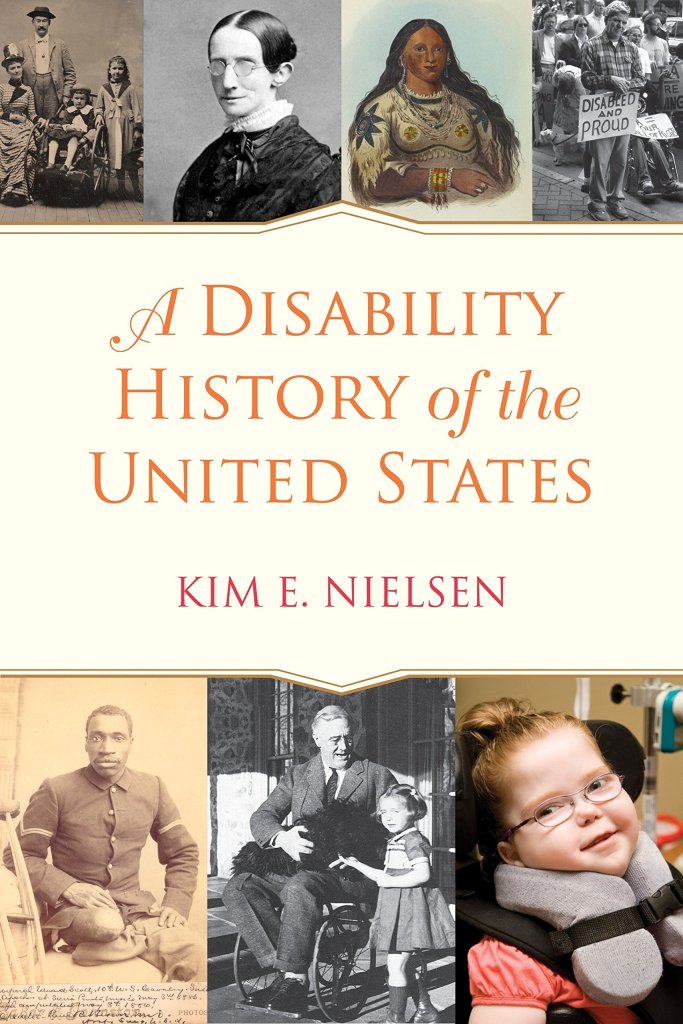
Book Report: A Disability History of the United States by Kim E. Nielsen

Genre: Historical Nonfiction
Published October 1, 2013

Brief Summary
Kim E. Nielsen is a professor of disability studies and history. As a result, she wrote the first book to place the experiences of disabled people at the center of the American narrative. Encompassing pre-1942 to 2013, this book shows how disabilities have been a significant factor in the formation of the United States, its values, and how it formed democracy.

Good morning Listen Up readers! This week I’ll be wrapping up the “Disability History” series and beginning the “Writing Characters with Disabilities” series. Check out the archive for more information as well as other upcoming series.

I have briefly mentioned A Disability History of the United States in Disability History, Part 1. It is one of few books on the market about disability history. With that being said, it is a shorter book—only 187 pages, not counting the works cited or the index. Despite its small size, there is so much information in this book! If readers would like to continue learning about disability history, this is the book I would recommend. It covers from pre-Colombus to 2013 and includes Native Americans’ perspective on disabilities, what having a disability meant in the original thirteen colonies, the rise of institutions, the Civil War, the Industrial Revolution, eugenics, and the Disability Civil Rights Movement. In addition, this book not only talks about the impact of disabilities but also how the concept of disabilities have changed over time. This happens due to cultural changes, which I’ll talk about a little later in this post.

A Disability History of the United States began with the argument that disability history is at the core of the American story. . . The experience of people with disabilities is pivotal to US history, just as the concept of disabilities is at the core of American citizenship, contested explorations of rights, racial and gender hierarchies, concepts of sexual deviance, economic inequalities, and the process of industrialization. There is no question that the power to define bodies as disabled has given justification, throughout US history, for subjugation and oppression.”

Nielsen, page 182

Knowing history is important, not only to teach to current and upcoming generations but also writers as they construct new worlds and culture. This is a mistake I see in a majority of stories. When writers create a world, there are often no disabled people or evidence of disabled people. Even worst, some stories state that all disabilities have been wiped out, which seems to be particularly common in science fiction. Even if all “disabilities” as we know and understand them today, are erased from existence, there will always be other disabilities that arise in their place. This is because disabilities are created by social and cultural means. An example I have used before: are wheelchair users disabled by their chair? Or are they disabled by a culture that relies on stairs? Most wheelchair users see their chairs as an extension of their body. It allows them to be free and independent, like wings that allow birds to fly. To non-disabled people, however, a wheelchair seems like a limitation.

Disability history provides a blueprint for writers, as history is a series of cultural changes. What I mean by cultural changes are events that affect, alter, or shift a culture. For example, whenever there is war there is a significant increase in people with disabilities. If a writer is working on a story that involves warfare, then naturally, disabled characters should be included. Another example of a cultural change is the industrial revolution, which left behind a huge wake of disabilities. Due to poor manufacturing processes and a severe lack of safety regulations, many factory workers lost fingers, limbs, lives, or received other injuries. Once a worker became disabled, they were seen as “defective” and promptly replaced. These disabled workers had trouble finding jobs and providing for themselves because of the stigmas attached to disabilities, which leads me to my next point.

“Given that disability was defined as the inability to labor, white women, free African American women, and slaves came to be associated with the disabled.”

Nielsen, page 56

The values of a culture will be reflected in how people with disabilities are treated. For example, one of the most important values in American culture is independence. When it comes to disabilities, not everyone is completely independent, thus this is one of the reasons why the disabled community has faced so much discrimination. This causes a culture clash, so there is a divide between independent Americans and interdependent Americans. Another great example of cultural values comes from the early immigration era (roughly 1870 to 1924). During this time, immigration to America was at an all-time high. But Americans only wanted American-like people coming in. This meant that people were being turned away for their skin color, their religion, their body shape (such as too tall or too short), being too old, for being poor, being suspected of a disability, among other things. Ellis Island (an immigration station where officials decided who could enter the country and who would be deported) was designed to be as inaccessible as possible. Steep, narrow stairs and pathways would test immigrants physically. If an immigration officer saw an immigrant struggling with stairs or running out of breath, they would be marked to be deported.

“When [President] Coolidge proclaimed that ‘America must be kept American,’ he had a very specific American body in mind.”

Nielsen, page 110
Ellis Island

Cultural values about independence and disabilities can also be found at the heart of discrimination against people of color.

“The racist ideology of slavery held that Africans brought to North America were by the definition disabled. Slaveholders and apologists for slavery used Africans’ supposed inherent mental and physical inferiority, their supposed abnormal and abhorrent bodies, to legitimize slavery. Indeed, slaveholders argue that the bodies and minds of those they enslaved were disabled to such an extent that slavery was a beneficial kindness owed to those in need of care. Disability permeated the ideology, experience, and practices of slavery in multiple and profound ways.”

Nielsen, page 42

The concept of disability applied to women as well, who were thought to be too weak and feeble to labor. Nor were they thought to be mentally capable of making educated decisions or allowed to vote.

Traveling back to the foundation of the United States; disability, like skin color, was a determining factor in whether or not a person could be a citizen of the new nation. This idea was challenged by the Revolutionary War, which left several disabled people in its wake. Thus, people who fought for the nation were no longer considered citizens, so disability had to be reevaluated. Any veteran with a disability would be a full citizen and had the right to vote. But if someone was born with a disability, they were not eligible for these things. This divide in particular says so much about America because even today, someone who becomes disabled as a result of warfare is treated differently than someone who is born with a disability or becomes disabled as a result of an accident.

This especially comes out in elections. When a politician has served, they will never fail to mention their service—particularly if they have a disability from it. But, at all other times, they will refuse to be seen as disabled. Like George Washington said during a campaign speech, “Gentlemen, you will permit me to put on my spectacles, for I have not only grown gray but almost blind in the service of my country” (77). His blindness served as a marker of his nobility and worthiness to be president, but for any other man, blindness would be seen as a defect.

George Washington is not the only president to have a disability. Franklin D. Roosevelt, who had polio that paralyzed his legs, needed to use a wheelchair. However, for speeches and other events, he walked short distances with the use of iron braces (hidden under his pants) and a cane to hide his disability from the public. He was particularly careful not to let the media photograph him with his wheelchair, as that would “damage” his image. Today, there are only a small handful of photos that exist of Roosevelt with his wheelchair. In photos where he is not sitting, you can see that he holds onto other objects or is supported by the arm of a family member.

All of this is but a scratch of the surface of what A Disability History of the United States has to offer.

So, to briefly summarize world-building for disabilities; look at the culture of the story and circumstances that affect it. If there is industrialization, slavery, warfare, poor or limited medical access, lots of illness or spreading of diseases, or high crime, there will be lots of disabilities. List the society’s main values. What do these fundamental values tell you about society? If society values things like independence or the ability to fight, what does that mean for disabled people in your world? What happens to people if they don’t meet the status quo? Who is considered a citizen or how is citizenship obtained? Are there divisions in disability, like the divide between disabled veterans and disabled people?

What does the architecture of your world say about disabilities? Are buildings and streets accessible? Are doorways wide enough for a wheelchair or someone on crutches? Is there sign language or closed captions for those with hearing disabilities? If the culture has rights for disabled people—how did they get them? If your world is missing people with disabilities, then where are they? Are they segregated or placed in institutions? What does that segregation tell you about society’s values?

Try to think about disabilities as a result of cultural circumstances and reflections, rather than as just a singular, individual character. If your society is progressive and has rights for disabled people, then there must be a disabled community to reflect disability pride. Even though I was born deaf, I didn’t grow as a disabled person until I started connecting with other deaf people. This is a common story in the disabled community. When disabled people can connect with other disabled people, it is like a spiritual experience. You can share your struggles with people who understand exactly what you are talking about, and oftentimes, you’ll hear things put into words that you’ve always known, but have never been able to explain. The disabled community is incredibly important to help characters grown.

The reason I mention the disabled community is I’ve seen quite a few situations where a writer composes a society that is discriminatory against disabilities (by clues like inaccessible architecture, exclusion/segregation, or the general attitude) but has a disabled character who is confident and bright in his/her disability but has never met another person with a disability—it comes off as not realistic. If a person is told their entire life that they are worthless, which is reinforced in so many subtle ways, it doesn’t make any sense for them to develop confidence in themselves without outside influence. If you are having trouble grasping this, flip the example to a different minority. If a black character grows up in a society that recently believed colored people should be slaves, it makes no sense for him/her to become self-confident in who they are without a reason. They likely have to act in certain ways and follow certain behavior guidelines, because being too confident or acting out of the ordinary, or behaving in any other way that society deems as “wrong,” can get them hurt or killed. It’s the same for those with disabilities.

“US disability history is not only the history of people with disabilities. Whether one’s life is shaped by able-bodiedness and the economic and legal advantages that issue from that, or by the economic and legal implications of disabilities’s long-stigmatized past, disability, both as lived reality and as concept, impacts us all. . .
“The story of the US nation is a contested, sometimes vicious, sometimes gloriously marvelous story of creating a national home. People with disabilities have been and will continue to be an integral part of that story. It is my home, our home, and your home.”

Nielsen, page 182-183

In short, this book does a fantastic job at tackling historical silencing and bringing awareness to the fact that America has been built by people with disabilities just as much as any other minority group. It is a great resource for writers who want to learn more about culture and what kind of circumstances or cultural changes are realistic for portraying characters with disabilities in building other worlds.

Did you like today’s post? Was it helpful to you? Leave a like or comment below to let me know!