Genre: Children’s Fiction
Published May 1, 2010
Summary
Enjoy tongue-twisting fun as readers get to know more and more about the life and personality of the Wonky Donkey with each turn of the page.

Good morning Listen Up readers! Today I am talking about one of the most popular children’s books on the market. In fact, The Wonky Donkey (TWD) has been a best seller for several years. As of writing this, it is listed as Amazon’s #1 Best Seller in Children’s Farm Animal Books and maintains a 5-star rating out of nearly 60,000 reviews. This is impressive considering how competitive the children’s book market is.
For those who are not familiar with the book, it follows a Donkey who uses a prosthetic leg (hence, how he got the name “wonky)” as he goes about his life. But the words used to describe the Donkey and his characteristics are subtly controversial. Nearly the entire first page of reviews on Amazon are 1-star ratings because of the word choice. The majority of other reviewers left 5-star ratings, often saying they were disappointed in the 1-star ratings and told others to “lighten up” about the word choice. I have included a few screenshots of these reviews. The following were retrieved on May 17, 2021, and were found on Amazon’s first page of reviews.
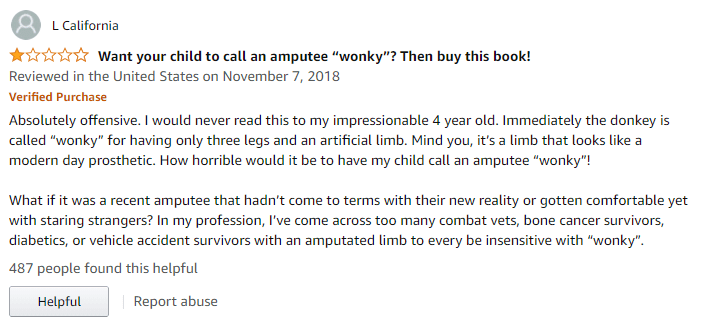
“Absolutely offensive. I would never read this to my impressionable 4 year old. Immediately the donkey is called ‘wonky’ for having only three legs and an artificial limb. Mind you, it’s a limb that looks like a modern day prosthetic. How horrible would it be to have my child call an amputee ‘wonky’!
“What if it was a recent amputee that hadn’t come to terms with their new reality or gotten comfortable yet with staring strangers? In my profession, I’ve come across too many combat vets, bone cancer survivors, diabetics, or vehicle accident survivors with an amputated limb to every be insensitive with ‘wonky’.”

“I have to be honest, I bought this book for myself. I’m a 62 year old grandmother whose grandmother whose grandchildren are all grown up, or enough that they don’t sit on my lap anymore. I loved this book. I’m disappointed that the very first review was 1 star because the write didn’t approve of the word “wonky” get over it. There are a lot of words that may not be proper, but this one hits the nail on the head. Thank you for my smile every time I read the book.
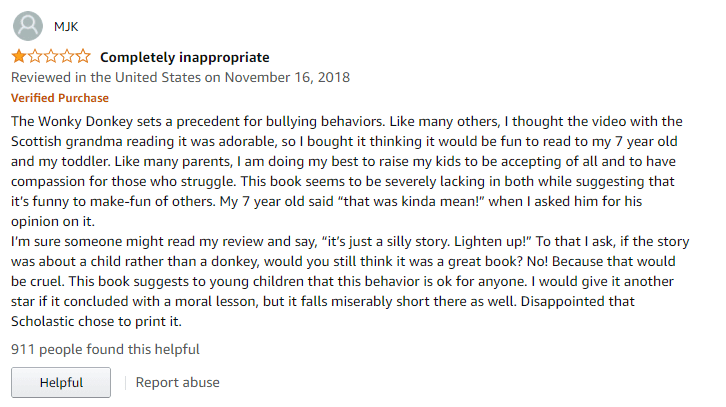
“The Wonky Donkey sets a precedent for bullying behaviors. Like many others, I thought the video with the Scottish grandma reading it was adorable, so I bought it thinking it would be fun to read to my 7 year old and my toddler. Like many parents, I am doing my best to raise my kids to be accepting of all and to have compassion for those who struggle. This book seems to be severely lacking in both while suggesting that it’s funny to make-fun of others. My 7 year old said ‘that was kinda mean!’ when I asked him for his opinion on it.
“I’m sure someone might read my review and say, ‘it’s just a silly story. Lighten up!’ To that I ask, if the story was about a child rather than a donkey, would you still think it was a great book? No! Because that would be cruel. This book suggests to young children that this behavior is ok for anyone. I would give it another star if it concluded with a moral lesson, but it falls miserably short there as well. Disappointed that Scholastic chose to print it.”
When I first read this book, I wasn’t sure what to think. I didn’t feel the author intended to make fun of the Donkey’s disabilities and it didn’t seem that offensive to me. But then I do not use a prosthetic or an eye patch. To help myself understand this issue better, I decided to ask myself how I would feel if the Donkey used hearing aids and was called something like “The Echoing Donkey.” This would be extremely insulting to me as a Deaf person. I regularly have to ask people to repeat things they say, then I repeat it back to them to make sure I understood what they said. It is a vital strategy for me to communicate and it isn’t easy. To have someone make a joke of that makes me angry. In this sense, words like “wonky” or “winky” are not mindful terms for someone who uses a prosthetic or an eye patch.

As I said, I don’t think the author intended to make fun of disabilities. I think he was focused on making a funny book and was largely successful. But the book does end up playing on ableist ideals which serves as an unconscious reflection of our culture’s perspective toward disabilities. What I mean by this people are opinionated when it comes to disabilities. My last series of blog posts covered the history of disabilities and the history of the disabled civil rights movement. One of the most challenging things that disabled civil rights activists faced was getting people to acknowledge that discrimination against disabilities did exist. I think that comes into play with TWD and why some people are fine with it and others are against it.
Because this seemed to be a controversial book, I wanted to have a second opinion on it. So, I decided to ask some of my friends who happen to be teachers, what they thought about the book and if they would include it in the classroom. Out of respect for their privacy, I will refer to them as Teachers A, B, C, and D.

Teacher A teaches kindergarten. When I pulled out my copy of TWD, she was excited as it was a book she had been considering for use, but initially decided against it because it mentioned coffee. (Coffee is a controversial subject in the state of Utah). She talked about the importance of kids learning to rhyme and the way it was used in TWD would help kids learn to build self-awareness. She saw the book in a very positive light as getting to know the Donkey beyond his disabilities.
Teacher B is a special education teacher. He didn’t like the book as he felt it was assigning labels. He also said that he wouldn’t use this book in the classroom from a practical standpoint, as rhymes are difficult for some of his kids. Which is a point I had not considered. It brings up a whole different perspective on the subject of writing inclusively when talking about writing for an audience with disabilities, but that is also an entirely different subject which I won’t be able to get into it today.
Teacher C, who is working toward her degree in education, had strong opinions on TWD. She pointed out the words used to describe the Donkey all had negative connotations and felt that the book in general was reinforcing stereotypes. “If it is not going to educate or show the beauty of disabilities, then it is ableist,” she said.
Teacher D is also working toward a degree in education and is a mother. Like Teacher A, she recognized that learning rhymes and self-awareness is important for kids. It is a fun book to read for both children and adults. But like Teacher C, she noticed the word choices all had negative connotations. “Disability isn’t really being represented here,” she said, “because it is an animal. It is using the missing leg and missing eye as something to laugh at.” She ended by saying that she would not use it in a classroom or read it to her kids.

Post-discussion, all the teachers said they would not use TWD in the classroom. This includes Teacher A, who had a positive perspective of the book at the beginning, but by the end of hearing what others noticed and thought about the book, said that she wouldn’t use it even if it didn’t mention coffee. She pointed out that there were plenty of other books available that teach kids rhymes and self-awareness which are more inclusive.
TWD has two sequels, The Dinky Donkey and The Grinny Granny Donkey, which are about the Donkey’s daughter and mother. The word choice in these books is similar to that of TWD, meaning that many of the words used to describe the characteristics of the main character have negative connotations, though the characters themselves don’t have disabilities. Which sparked a new train of thought in my brain.
Donkeys, because they are associated with labor and lower class standing, are not thought of as being majestic creatures. Donkeys are generally expect to be dirty, smelly, stubborn, stupid, and grumpy. In that sense, the negative word association fits within that context. If TWD was a story about a donkey without disabilities it would probably be socially acceptable. Maybe the Donkey is having a bad day and stubs his toe and walks a little wonky from that. Then he gets something in his eye and becomes winky trying to get it out. The words haven’t changed, but the story isn’t as controversial anymore. Yes, readers are still laughing at a donkey, but in our society, it seems to be more socially acceptable to laugh at a dirty, stinky donkey than a dirty, stinky, disabled donkey.
All in all, The Wonky Donkey is a short book that sparks a lot of thought on the subject of stereotypes, word choices, and cultural perspectives. It also highlights a lack of awareness and education among writers and publishers on issues surrounding writing disabilities. On a personal note, my biggest issue with TWD is that this it is a children’s book. Books such as this start teaching ableist ideals to young children, thus encouraging another generation to continue believing the stigmas surrounding disabilities and the illogical exclusion of disabilities from society and stories. These issues are subtle in TWD, but important issues nonetheless.
What is your opinion on The Wonky Donkey? Comment below and let me know!
In my previous post, I mentioned that I might be switching to posting every other week rather than weekly. I have decided to proceed with that. This will allow me to have a better work-life balance, enable me to work on other writing projects while continuing to write quality blog posts for you. Thank you for your understanding and continued support!





 Listen Up